

🇮🇹Rome Hidden Gems: Free Viewpoints, Quiet Squares and Overlooked Ruins
For a second visit, or a first one that doesn't stop at the checklist: free terraces over the city, squares worth a detour, galleries with Caravaggios in them, ruins outside the centre, and the churches holding masterpieces for free.
2026-08-22
If you've been to Rome once already, or you'd rather not spend the whole trip in queues, this is the list that gets you away from the crowds.
Viewpoints over the city
- Pincio Terrace — free, on the east side of Piazza del Popolo. The easiest free viewpoint to reach in the centre, and a good one for sunset.
- Giardino degli Aranci (the Orange Garden) — free, on the Aventine south of the centre, not far from the Bocca della Verità. Another strong sunset spot.
- The Aventine Keyhole — look through the keyhole of the Knights of Malta priory door and you see the dome of St Peter's framed at the end of a hedge avenue. You're technically looking across three sovereign entities at once: the Order of Malta, Italy and the Vatican.
- The Vittoriano terrace (Altare della Patria) — €10, on top of the enormous white monument on Piazza Venezia. The one place you can photograph the Colosseum and the Forum in the same frame.
- The Janiculum Hill — a larger area than the others, with the Fontana dell'Acqua Paola partway up.
- Belvedere terrace — free, at the end of Via Piccolomini. Genuinely obscure, and out of the way.
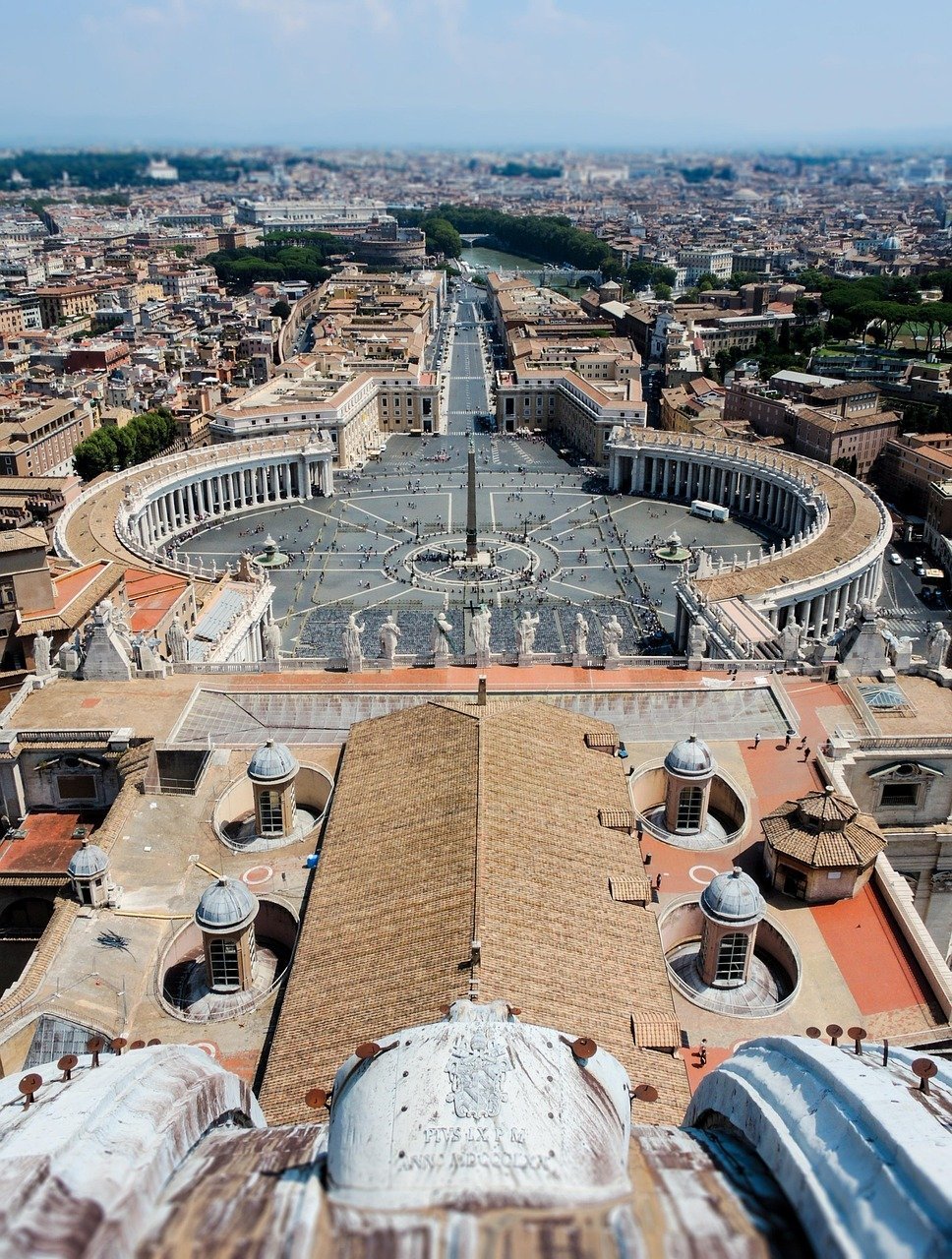
Squares and fountains
Rome has an enormous number of squares. Some are transport hubs, some are worth a detour for one specific thing:
Piazza della Repubblica (by the station) · Piazza Venezia (unavoidable on the walk from the centre to the Roman ruins) · Piazza del Popolo (metro on the north side, Pincio terrace to the east) · Piazza Barberini (Bernini's fountain) · Piazza del Campidoglio (backing onto the Roman Forum) · Piazza della Minerva (the elephant and obelisk, next to the Pantheon) · Campo de' Fiori (a working morning market, outdoor restaurants at night) · Largo di Torre Argentina (a sunken Roman ruin that is also a cat sanctuary) · Quattro Fontane (four Renaissance fountains at one crossroads) · Fontana dell'Acqua Paola (on the Janiculum, with the city below).
Museums and galleries
For anyone with an appetite for art and history:
- Capitoline Museums — a vast holding of Roman sculpture
- National Gallery of Modern Art — Klimt, Monet, Van Gogh, Rodin
- National Gallery of Ancient Art — split between Palazzo Barberini and Palazzo Corsini; essential if you like Caravaggio
- National Roman Museum — four sites, Roman antiquities
- Doria Pamphilj Gallery — home to Velázquez's Portrait of Innocent X
Roman ruins beyond the obvious
In the city: Via dei Fori Imperiali, running between the Colosseum and Piazza Venezia, with Trajan's Market the most impressive thing on it · the Temple of Venus and Roma, the largest Roman temple known · the Circus Maximus, the first and biggest of Rome's chariot stadiums · the Baths of Caracalla, the city's second-largest public baths, €8 · the Pyramid of Cestius · the Mausoleum of Augustus.
Just outside: the Appian Way Regional Park, one of the most important roads of the Roman world, covering 3,400 hectares; and the Aqueduct Park, around 240 hectares. Both are for visitors who want the ancient city without the crowd.
Churches
Rome has over 900 churches, and several hold major works that cost nothing to see:
- Santa Maria della Vittoria — Bernini's Ecstasy of Saint Teresa
- San Luigi dei Francesi — Caravaggio's Calling of Saint Matthew and Martyrdom of Saint Matthew
- Santa Maria del Popolo — Caravaggio's Crucifixion of Saint Peter and Conversion of Saint Paul, plus Bernini sculpture and a chapel designed by Raphael
Back to the Rome travel guide for the standard list and the classic three-day route.