

What to Pack for Europe 2026: Plug Adapters, SIM Cards, and What to Leave at Home
Europe is not one plug standard — the UK and the continent are entirely incompatible. Adapters, charging kit, European SIMs and eSIMs, documents and insurance, clothes and shoes, plus the things that are pure dead weight.
2026-08-13
Two things shape what you should pack for Europe: you'll move between cities by train, and a lot of accommodation has no lift. Packing light matters more than packing thoroughly. But power and connectivity are the two areas where getting it wrong ruins your first day.
This is sorted into must-bring, worth-bringing, and leave-at-home.
1. Power: Europe is not one plug standard
This is where most people get caught out — UK and continental European plugs are completely incompatible.Continental Europe (France, Italy, Germany, Spain, the Netherlands, Austria, Greece and most others): two round pins, Type C / Type F.
UK and Ireland: three rectangular pins, Type G. Not compatible with continental plugs — take the Eurostar from Paris to London and you need a different adapter.
Switzerland: Type J, three round pins in an unusual arrangement. Two-pin European plugs fit, but earthed three-pin European plugs do not. Check that your adapter explicitly supports Switzerland.
Some older Italian buildings: Type L, three round pins in a line. Most sockets these days are hybrid and accept standard two-pin European plugs.
Which adapter to buy
Get one universal travel adapter that covers the continent, the UK and Switzerland — cheaper and simpler than buying three. Look for three things:
- USB-A and USB-C ports, ideally with USB-C at 20W or higher, so your phone and the adapter share one wall socket
- Multiple outlets: European hotel rooms often have only one or two accessible sockets, so a multi-port adapter effectively becomes a travel power strip
- Don't buy a voltage converter. Europe runs at 220-240V, and phone, laptop and camera chargers are all dual-voltage (100-240V) — a plug adapter alone is enough. Only a small number of 110V-only appliances (some North American hairdryers and styling tools) need a converter, and those draw too much power for most travel converters anyway. Leave them behind.
One practical tip: bring two adapters. One stays in the room charging things overnight, one lives in your day bag (cafés and trains often have sockets). Adapters are among the most commonly forgotten items in hotel rooms, and a spare is cheap.
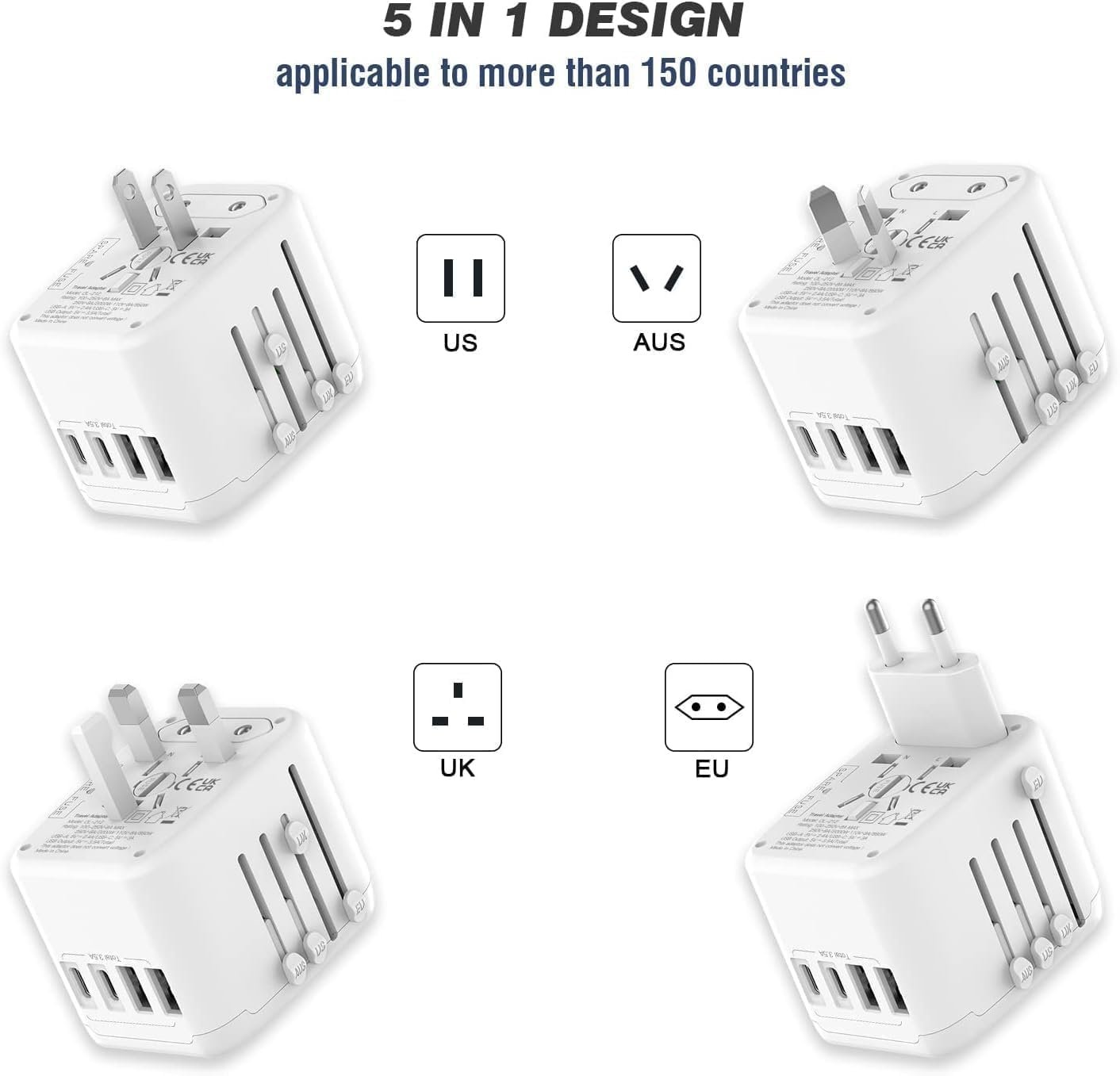
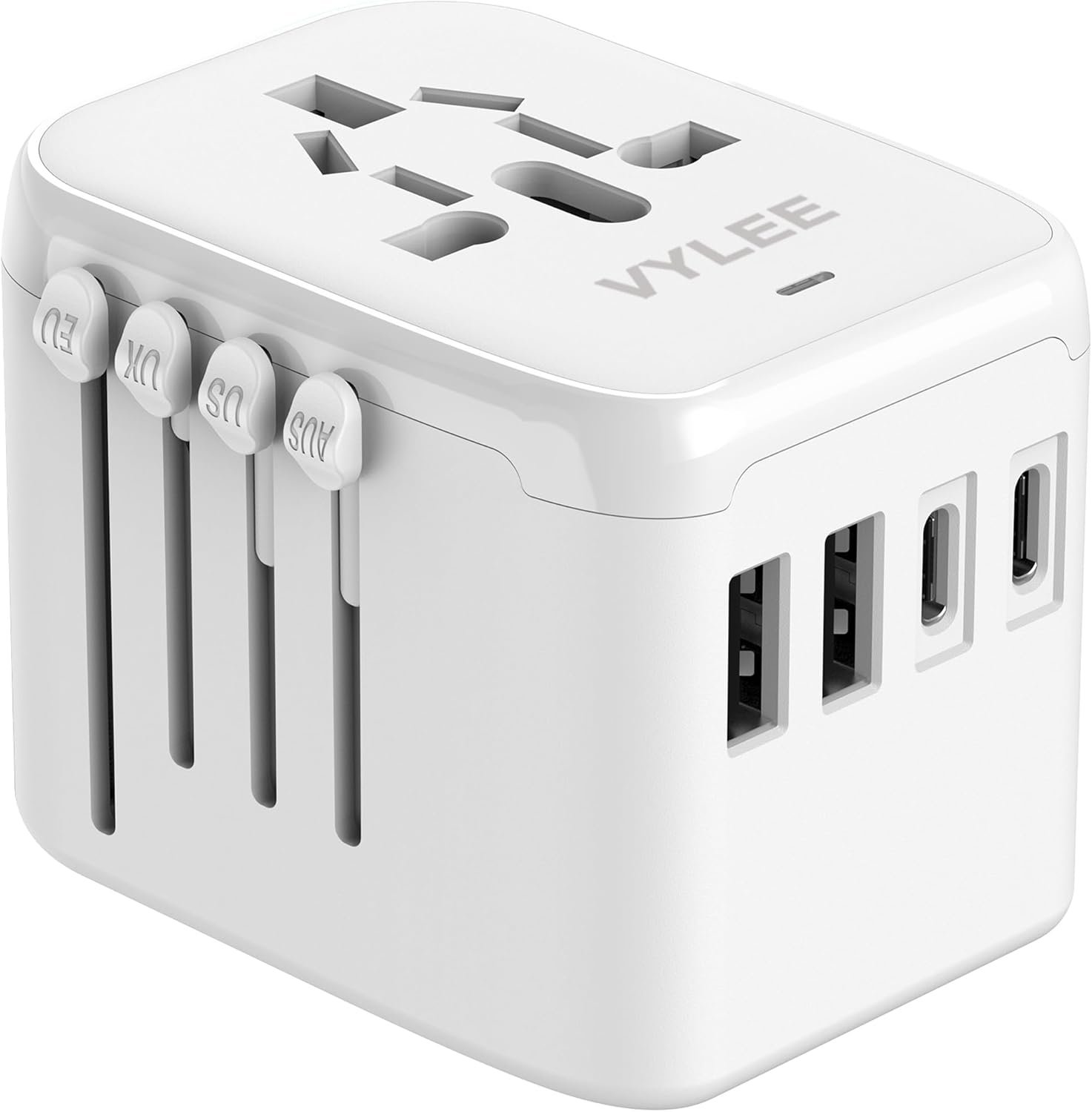
Universal travel adapter (EU / UK / US / AU, with 2x USB-A + 2x USB-C)
Amazon
Four sliders release the EU, UK, US and Australian pins, and the socket on top takes plugs from any of them. The EU setting is a two-pin Europlug, which as noted above does fit Swiss sockets.
As an Amazon Associate we earn from qualifying purchases.
Charging kit
Power bank: European sightseeing days are long and navigation runs constantly, so phones rarely last until evening. Must go in your carry-on — never checked. The usual limit is 100Wh (roughly 27,000mAh).
Cables: bring a spare. You can buy them in Europe, but at two or three times the price you're used to.
A multi-port USB-C charger: one 65W GaN charger will handle a phone, tablet and laptop at once, in half the space of three separate chargers.
Note: many European hotels now have USB ports built into the bedside, but the output is often very low and painfully slow. Don't rely on them.
2. Connectivity: how to handle data in Europe
Start with this: roaming within the EU is free. A SIM bought in any EU country works in every other EU country at no extra charge (the "Roam Like At Home" rule). One SIM covers the whole trip — you don't need a new one per country.
Exceptions: the UK is outside this rule post-Brexit, and Switzerland is not in the EU. Check whether your plan covers those two before you buy.
Three approaches:
1. eSIM — usually the best option
- Buy and install before you leave; you have data the moment you land, with no shop visit and no swapping cards
- Major providers cover all of Europe. Expect roughly US$5-10 for 7 days, US$20-30 for 30 days, depending on data allowance
- Your original number stays active for verification texts (just leave data roaming off on that line)
- Requirement: your phone must support eSIM. iPhone XS and later, plus most recent Android flagships, do — confirm in settings before you travel
2. Buy a local physical SIM on arrival
- Available at airports and phone shops; usually slightly cheaper than eSIM with more generous data
- Downsides: queueing, paperwork (some countries require passport registration), and physically swapping your card (don't lose the original)
- Makes sense for stays over two weeks or heavy data use
3. Roaming on your home plan
- Simplest but usually the most expensive. US carrier day passes run US$10-12 per day
- Only worth it for short trips of a few days, or if your employer is paying
Practical tip: install and test your eSIM before departure, not on arrival. Some eSIMs need an internet connection to activate — which you won't have if you've just landed.
3. Documents and money
- Passport: valid for at least 3 months beyond your departure from the Schengen Area, and issued within the last 10 years
- Entry authorisation: Schengen visa if required, or confirmation that your passport is visa-exempt. The UK additionally requires an ETA.
- Insurance documents: Schengen visa applications require €30,000 medical cover. Visa-exempt entry doesn't mandate insurance, but European emergency care is expensive — buy it anyway.
- Two credit cards from different banks, kept in separate places, so a frozen or swallowed card isn't a crisis. Prioritise cards with no foreign transaction fee.
- A little cash: €100-200 for small shops, markets, public toilets and emergencies. Almost everything else takes cards.
- Photos of your passport and insurance policy saved on your phone and in the cloud — essential if the originals are lost
The ATM trap: when a machine asks whether to charge in your home currency or the local one, always choose the local currency (euros). Choosing your home currency hands the machine operator the exchange rate, and they take several percent. The same applies when a card terminal asks in a shop.
4. Clothes and shoes
Shoes are the single most important thing you'll bring. European old towns are cobblestone throughout, and 20,000-30,000 steps a day is normal.
- One pair of well-broken-in walking shoes — do not start a trip in new shoes — plus a backup
- Cobblestones are brutal on stiletto heels; go for a low or block heel if you need something dressier
Dress in layers. Day-to-night temperature swings are significant, and even in summer, mountain areas and church interiors are cold. A light jacket earns its space year-round.
A waterproof jacket beats an umbrella. Rain in Britain, the Netherlands and Switzerland tends to be intermittent drizzle with wind, which umbrellas handle badly.
Church dress codes: St Peter's Basilica, Milan's Duomo and the Meteora monasteries in Greece all enforce them — no bare shoulders, and nothing above the knee. A light scarf in your day bag beats being turned away at the door.
5. Small things that earn their space
Bring:
- Basic medication: European pharmacies require prescriptions for a lot of things sold over the counter elsewhere. Pack painkillers, cold medicine, anti-diarrhoeal, plasters and motion sickness tablets.
- Prescription medication in original packaging, with a copy of the prescription for customs
- Toothbrush and toothpaste: many European hotels don't provide them. This catches people out on night one.
Worth bringing:
- A refillable water bottle: tap water is drinkable in most of Western Europe, and Paris and Rome have free public fountains everywhere
- A foldable shopping bag: European supermarkets charge for bags
- A crossbody or under-clothes wallet: not essential, but genuinely useful on the metro in Rome, Paris and Barcelona
- Travel-size toiletry bottles: carry-on liquids are capped at 100ml per container, all fitting in one 1L clear resealable bag
- Eye mask and earplugs: for the overnight flight and for street-facing rooms in old town centres
- A travel kettle: European hotels usually don't provide one — that's a British and Asian convention, not a continental European one. If you want hot drinks, instant noodles, or formula for a baby, you're on your own. Buy a dual-voltage 120-240V model — search for Dual Voltage 120-240V Portable Electric Kettle. A 110V kettle from North America won't boil in Europe. And because kettles draw a lot of power, plug it straight into the wall through a plug adapter — never through a voltage converter or a travel power strip, which will overload
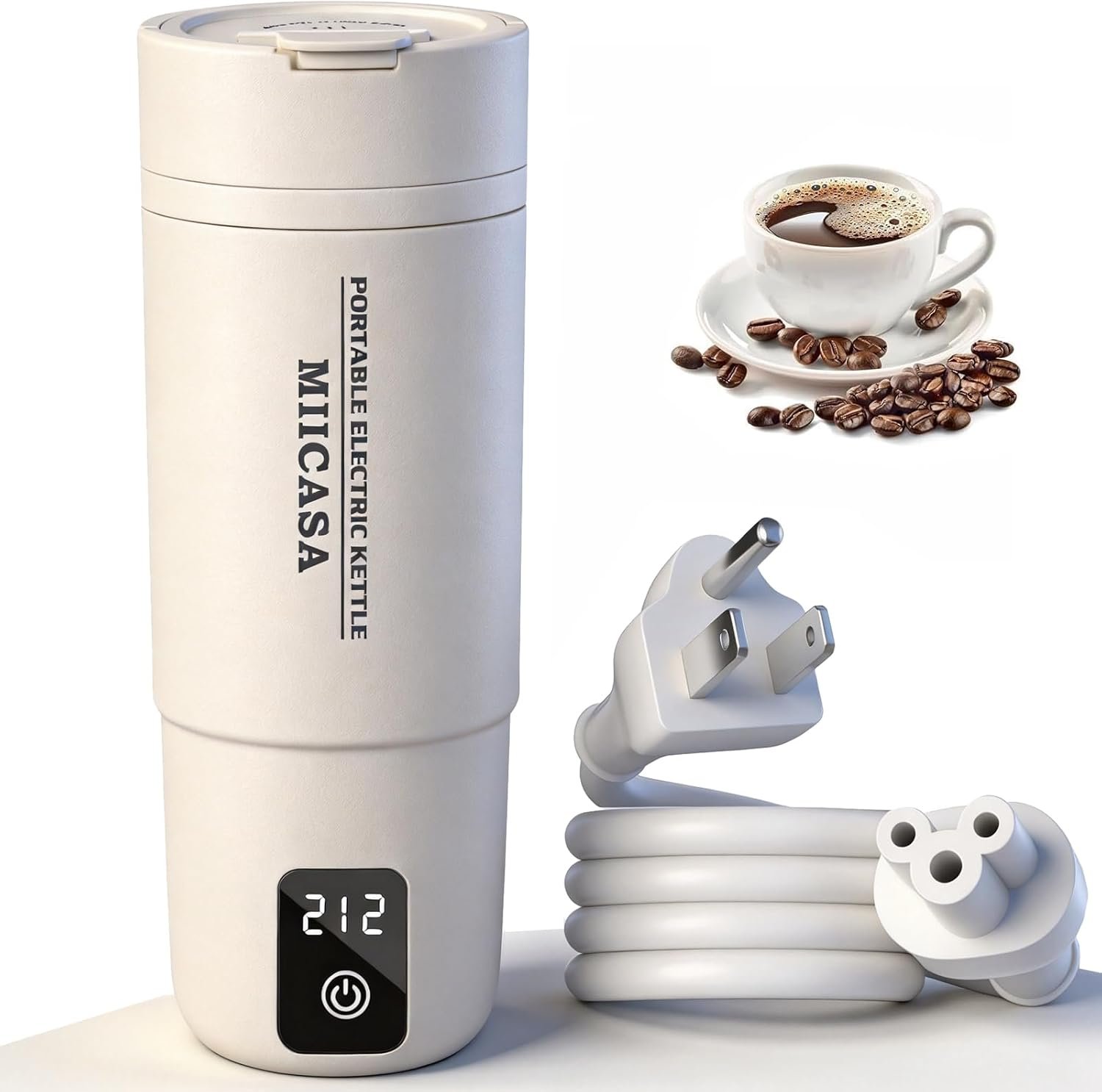
Travel kettle (dual voltage 120-240V)
Amazon
Dual voltage is the thing that matters — it works on European 220V and North American 120V alike. Six temperature presets and boil-dry protection. Plug it into the wall via an adapter, not a travel power strip
As an Amazon Associate we earn from qualifying purchases.
6. Leave these at home
- Voltage converters — as above, nearly all modern electronics are dual-voltage. Pure dead weight.
- A hairdryer — essentially every hotel has one, and yours probably won't match the voltage
- Large amounts of cash — card acceptance is near-universal; extra cash just increases what you lose if you're robbed
- Too many clothes — laundromats are everywhere. For ten days, pack five days' worth.
- A large hard-shell suitcase — if you're taking trains and staying in old-town apartments (many on the fourth or fifth floor with no lift), a 24-inch case is vastly easier than a 28-inch one
- Power strips — a home-market strip won't fit European sockets anyway, and a multi-port adapter does the job better
FAQ
Can I drink the tap water?
In most of Western Europe, yes — it meets drinking standards. Paris, Rome and Munich have plentiful free public fountains. In a few older buildings the plumbing is dated; if you see "eau non potable" or "acqua non potabile", don't drink it.
Will mobile payments work?
Apple Pay and Google Pay are widely accepted across Europe. Plan on cards as your default and carry a little cash for the exceptions.
Can I bring a power bank on the plane?
Yes, but it must be in your carry-on and never in checked baggage. The standard limit is 100Wh (about 27,000mAh); anything larger needs airline approval.
eSIM or a local SIM?
For trips under two weeks, eSIM — simpler, no card swapping. For longer stays or heavy data use, a local physical SIM is better value.
Is one adapter enough?
Technically yes, but bring two. Adapters are the item most often left behind in hotel rooms, and European hotel sockets are scarce to begin with.
For keeping a large case safe on trains, see Luggage Theft on European Trains.
Also worth reading before you go: Visa-Free Entry to the Schengen Area.
General pre-trip guidance. Socket standards and airline baggage rules change — confirm with your airline and destination sources before departure.