

Luggage Theft on European Trains 2026: AirTags, Locks, and Where to Put Your Bag
Large suitcases don't fit in the overhead rack, so they end up by the doors where you can't see them. When thieves actually strike, how to set up an AirTag, what a TSA lock does and doesn't prevent, and the three things to do if a bag goes missing.
2026-09-05

The uncomfortable part of European intercity rail: a large suitcase won't fit in the overhead rack, so it goes in the vertical luggage bay at the end of the carriage — usually out of your line of sight.
Rome to Florence, Paris to Nice — you sit for an hour or two while your case stands alone by the door. Here's how to deal with that.
First, understand when thefts actually happen
Knowing the pattern is worth more than any piece of kit.
The dangerous window is the two minutes before the train pulls into a station. Nobody drags a large suitcase down a moving carriage. They lift it from the bay as the train slows, step onto the platform, and disappear into the crowd. By the time you reach your own stop, they're long gone.
Second most dangerous is boarding chaos at the origin station. Everyone is finding seats and wrestling with bags — nobody notices someone leaving with one extra case.
The classic two-person setup: one person creates a distraction near you (asking directions, pretending to look for a seat, dropping something at your feet) while the other works the luggage bay at the far end.
Higher-risk routes: the Rome–Florence–Venice corridor in Italy, and the big stations — Roma Termini, Milano Centrale, Firenze SMN, Napoli Centrale. In France, Paris Gare du Nord and the Paris–Nice line. In Spain, Barcelona Sants. Night trains are a separate scenario, where the risk starts once you're asleep.
Option 1: Put a tracker on the case
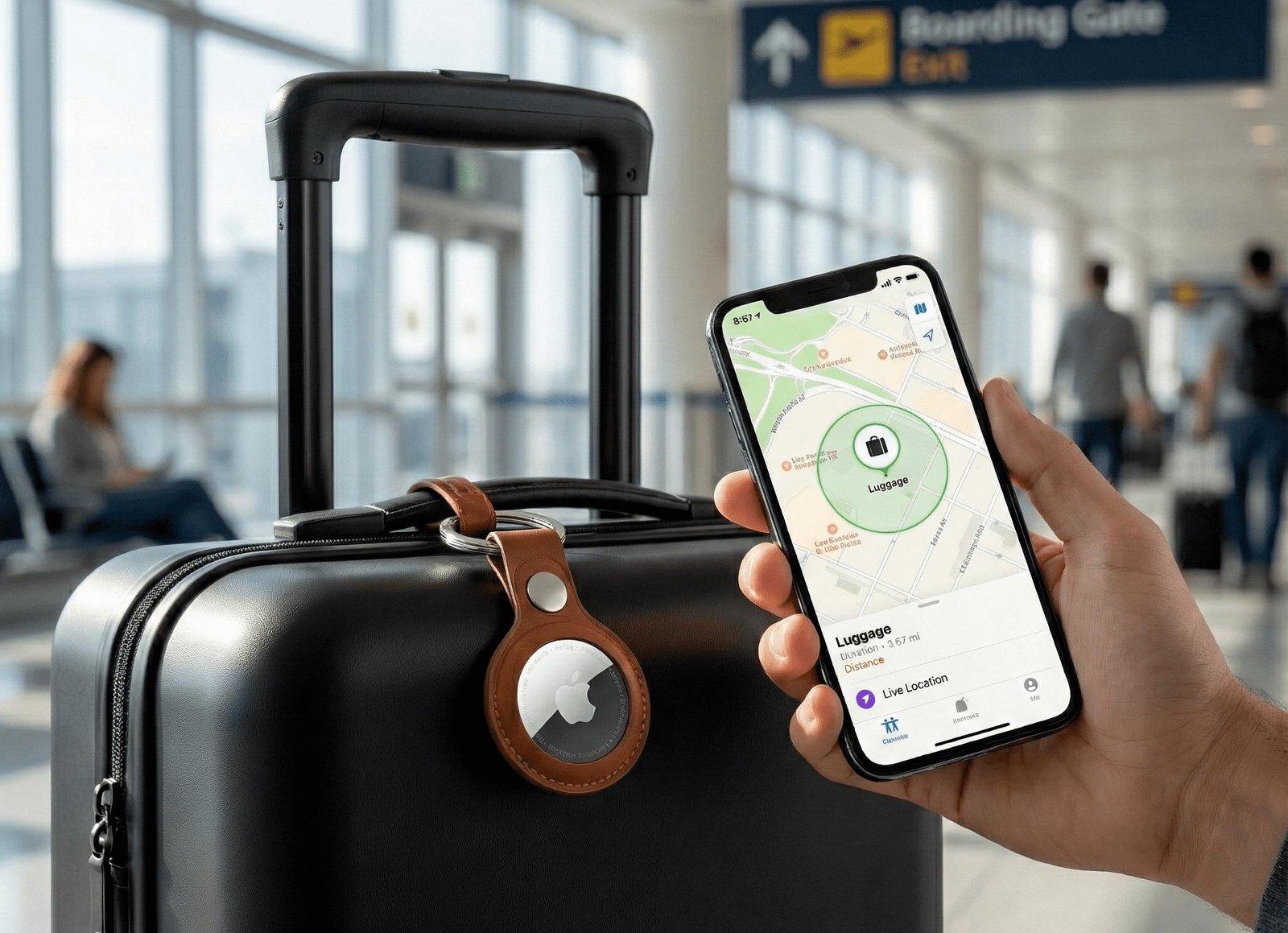
To be clear: a tracker does not stop your bag being taken. It solves the problem of knowing where it went. That turns out to matter a lot, because most lost luggage isn't stolen by professionals — it's picked up by mistake, moved to another carriage, or sent to the wrong airport.
Apple AirTag (iPhone users)
How to attach it:
- Buy an AirTag holder with a clip and attach it to the suitcase handle. Easiest option, but conspicuous — anyone who's paying attention can remove it. If it's going on the outside, choose a steel-cable holder rather than a plastic clip — a plastic clip pops open in a second, whereas a steel cable needs cutters, and nobody is going to do that in a busy carriage.
- A more robust approach is inside the case: tucked into the lining pocket or buried among clothes. Tracking accuracy is unaffected, and it isn't visible at a glance.
- Ideally use two: one on the handle so you can find your own bag quickly, one hidden inside as the backup if the bag is actually taken.
How to set it up:
- Hold the AirTag near your iPhone — a pairing prompt appears automatically
- Give it a name ("Big suitcase")
- It then shows up under the Items tab in the built-in Find My app
Why it works in an unfamiliar city: an AirTag has no GPS and no SIM. It relies on the Find My network — hundreds of millions of Apple devices worldwide anonymously and securely relay its location back to you as they pass by. In European train stations, airports and city centres, that means location updates arrive fast. In sparsely populated countryside, it might be hours between updates.
Features worth knowing:
- Precision Finding — within close range, your iPhone points an arrow with a distance readout. Genuinely useful for finding your bag at the other end of a carriage.
- Play Sound — makes the AirTag chime within Bluetooth range, handy in a pile of identical black suitcases
- Lost Mode — flag it as lost and you're notified the moment the Find My network detects it. Whoever finds it can tap their phone to it and see your contact details.
- Share Item Location with an airline — if checked baggage is delayed, your iPhone can generate a location link to send the airline. Most major carriers now accept these.
Battery: one CR2032 coin cell, about a year of life, available in any supermarket or pharmacy. Fit a fresh one before a long trip.
One limitation you must know about: Apple runs anti-stalking protection. If an AirTag that isn't theirs travels with someone for a while, their iPhone — or an Android phone with the detection app — will alert them, and they can then find and disable it. Against a prepared professional thief, an AirTag won't last long. Its real value is the golden tracking window in the first few hours.
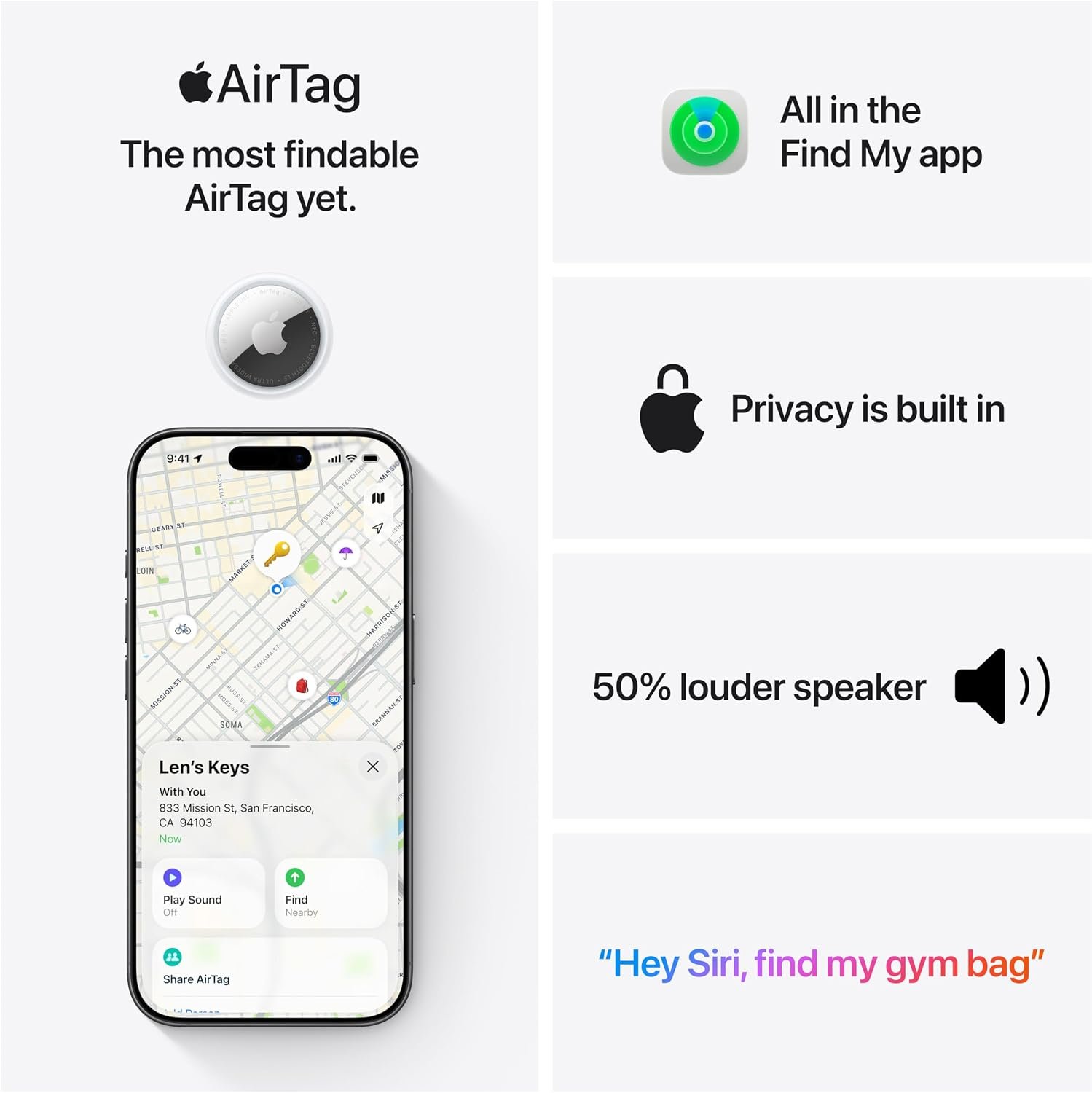
Apple AirTag (2nd generation, single)
Amazon
The second generation has a louder speaker and longer Precision Finding range. The one-on-the-handle, one-inside approach above needs two per case, and multi-packs usually work out cheaper. The CR2032 battery is user-replaceable — fit a fresh one before a long trip
As an Amazon Associate we earn from qualifying purchases.
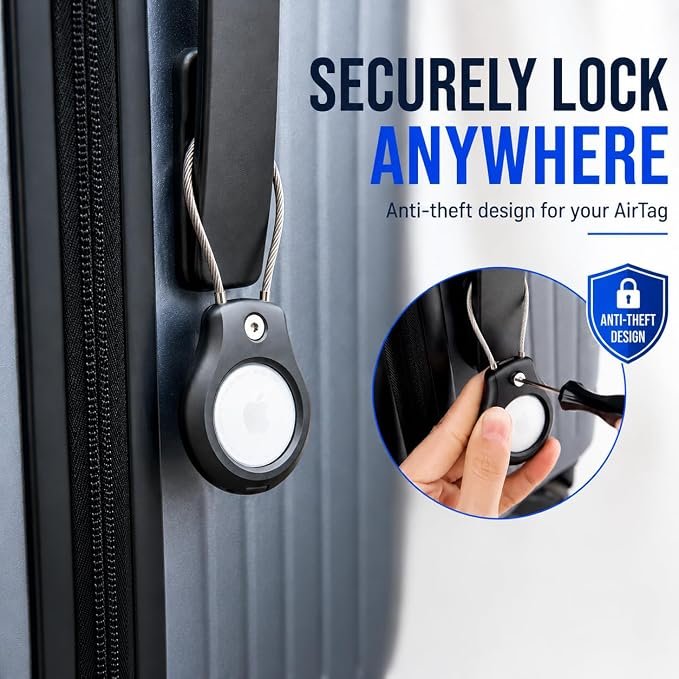
AirTag steel-cable holders (4-pack)
Amazon
Steel cable is far harder to remove than a plastic clip, which is what you want on an exposed handle. The tag hidden inside the case doesn't need a holder at all
As an Amazon Associate we earn from qualifying purchases.
Android users
Google's Find Hub network (formerly Find My Device) works on the same principle, relaying via Android handsets. Compatible tags include Chipolo POINT, Pebblebee and the Motorola Moto Tag. Samsung owners can use SmartTag, which runs on Samsung's own network — dense enough in Europe to be useful.
Tile is the cross-platform veteran, but its network density lags Apple's and Google's, and it performs unevenly in Europe.
Option 2: Locks
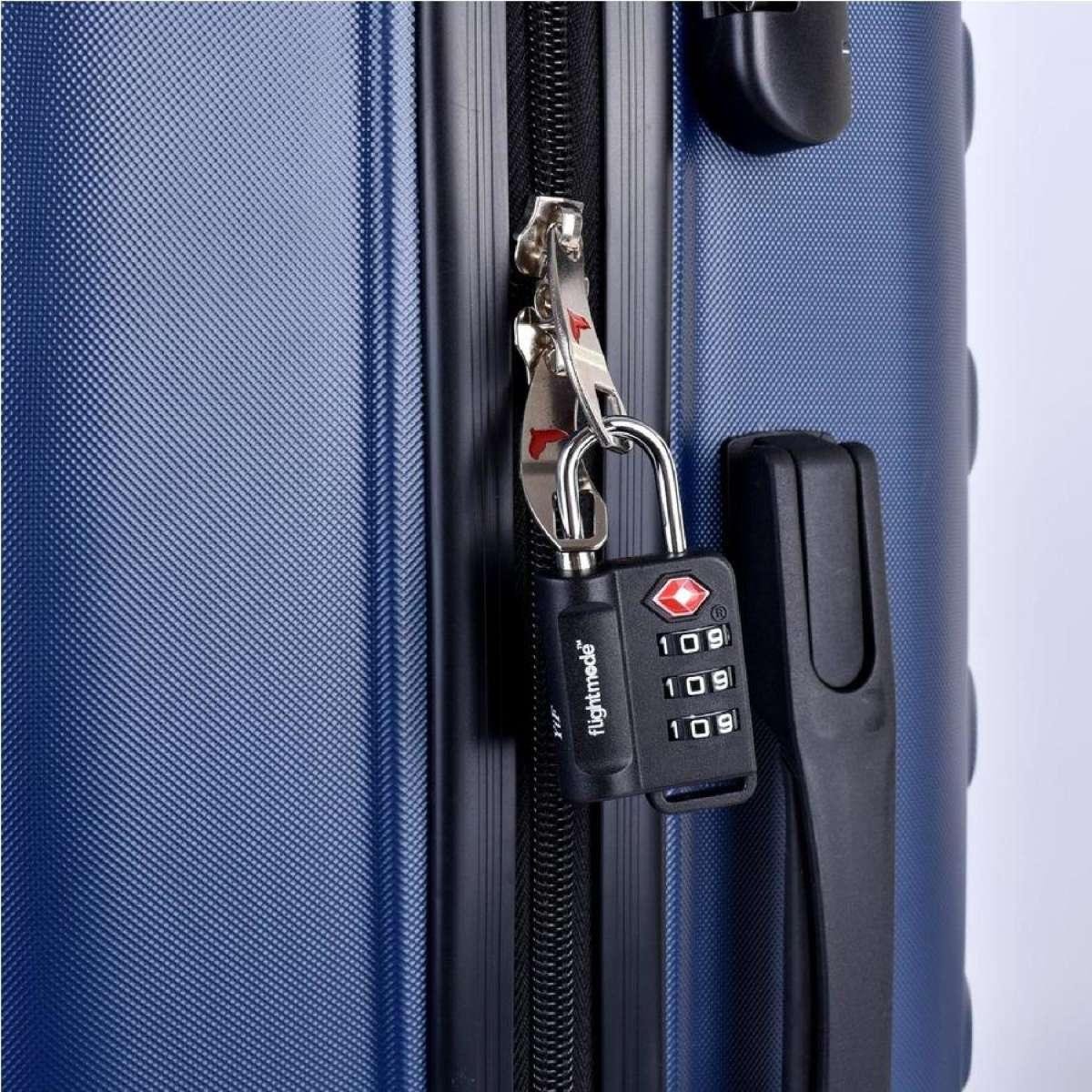
Think of locks in two separate categories — some prevent opening, some prevent removal. They are not the same problem.
Combination and TSA locks: preventing opening
What they do: stop someone unzipping your case and going through it while you're not looking. That matters in the train luggage bay, in hotel rooms, and in hostels.
Choose TSA-approved locks (marked with the red diamond). If your itinerary includes a US flight segment, checked bags must use TSA locks — otherwise security will simply cut them off to inspect the bag.
Two honest limitations:
- TSA locks open with a universal master key set, and images of those keys have circulated online for years. Against a professional, they're close to useless.
- Zip-closure cases have a well-known weakness: a ballpoint pen pushed through the zipper teeth opens it, and sliding the pulls back closes it again with no visible trace. No lock prevents this — which is why valuables should never be in a bag that leaves your hands.
The conclusion: a combination lock defends against opportunists, not professionals. But the overwhelming majority of European train luggage theft is opportunistic.
Cable locks: preventing removal
This is the single most effective item for trains, and the one almost nobody carries.
A cable combination lock about a metre long, threaded through the suitcase handle and locked to the upright post or rail of the luggage bay. The logic is simple: the thief wants a three-second lift-and-walk. Anything that requires crouching down and working at it makes them move to the next bag instead.
- Choose plastic-sheathed cable so it doesn't scratch your case or the carriage
- Combination beats keyed — keys are far too easy to lose while travelling
- Cutting through it needs tools and time, which is exactly what a thief doesn't have
Also useful for: hostel lockers, left-luggage areas, and night train compartments.
Option 3: Free habits that work better than gear
Choose a seat near the luggage bay. If your booking system lets you pick, take a seat near the carriage end. Most show a carriage diagram.
Use the overhead rack whenever you can. Cabin-size cases (20-22 inch) fit overhead — this is one of the real reasons not to bring a 28-inch case on a multi-city European trip, quite apart from carrying it.
Put your case at the back and bottom of the bay. The top outer bag is the one that gets taken.
Turn the handle inward so it isn't easy to grab in one motion.
Valuables always stay on you. Passport, cash, cards, laptop, camera, medication go in a small bag that stays at your feet or on your lap — never in the large case, at any point.
Glance back before each stop. When the station announcement comes, look toward the luggage bay. The act of looking is itself a deterrent.
Night trains: lock the compartment, and a door wedge helps on some carriages. Keep your day bag in the bunk with you, not on the floor.
If a bag does go missing
1. Check and screenshot the location in Find My / Find Hub immediately. A timestamped location record is useful to both police and insurers. Do not go after it yourself. A pin on a house or street is not an invitation to knock on the door — hand the information to the police.
2. File a police report. Denuncia in Italy, déclaration de vol in France. Don't skip this — insurance claims, emergency passports and any claim against the railway all require it. Major stations usually have a police post inside. The Europe-wide emergency number is 112.
3. Notify your insurer within 24 hours. Most travel policies require notification within 24 hours plus the police report before they'll process a claim. Save your policy number and claims line in your phone before you leave.
Also: for a lost passport, file the report first, then contact your consulate. Freeze cards by phone. Remote-lock your phone.
FAQ
Can AirTags fly? Can they go in checked baggage?
Yes. The CR2032 coin cell is far below aviation thresholds, and major airlines and regulators explicitly permit them in checked bags.
Will a thief find the AirTag?
Possibly. Apple's anti-stalking alerts notify someone when an unfamiliar AirTag has travelled with them for a while. Hidden inside the case is less obvious than clipped to the handle, but neither is guaranteed. Treat it as a tool for buying a golden tracking window, not as insurance.
Is anyone watching the luggage on European trains?
Generally no. Some long-distance sleepers and first-class carriages have an attendant present, but they aren't responsible for individual bags. A few high-speed services (Spain's AVE, for example) screen bags before boarding, but that's for dangerous goods, not theft.
Will the railway compensate me?
Usually not. European operators' conditions of carriage generally place responsibility for hand luggage on the passenger, and theft falls outside carrier liability. Your own travel insurance is what you're relying on — which is why the police report matters so much.
Is a 28-inch case realistic for European rail travel?
It's possible, but accept two things: it will never fit overhead and must go in the end-of-carriage bay, and plenty of old-town accommodation has no lift. For an itinerary covering three or more cities, 24-inch or smaller is strongly recommended.
Before you go, see What to Pack for Europe. For city-level pickpocketing, see Paris Pickpocket Safety Guide and Rome Public Transport Guide.
General safety guidance. Product features and airline/rail rules change — check manufacturer and carrier sources. In an emergency, call 112.