

🇫🇷Louvre Museum Guide 2026: Skip-the-Line Tickets, Which Entrance to Use, and a 1.5-Hour Highlights Route
The best way to book Louvre tickets, which of the four entrances to pick, how to plan a 1.5-hour highlights route, and exactly where to find the Mona Lisa, Venus de Milo, and Winged Victory.
2026-08-10
The Louvre is the most-visited art museum on earth, with roughly 35,000 works on permanent display across eight departments: Egyptian antiquities, Greek and Roman antiquities, Near Eastern antiquities, Islamic art, paintings, sculpture, decorative arts, and prints and drawings. (Anything after 1848 — Van Gogh, Monet, and the rest — lives across the river at the Musée d'Orsay.) The official site is louvre.fr. Plan for anywhere from three hours to a full day. First-time visitors almost always trip up on the same three things: booking, picking an entrance, and mapping out a route. This guide covers all three in the order you'll actually need them.
Booking: which of the three ticket channels should you use
Every visit now requires a timed entry slot booked in advance — showing up and queuing at the door is a bad plan. In peak season, walk-up ticket windows often sell out before noon.
- Official site (louvre.fr): The cheapest option, but release dates follow a fixed pattern — tickets for an entire month go live on the first Wednesday of the previous month, and popular morning slots (9-11am) can sell out the same day they're released.
- Paris Museum Pass (parismuseumpass.fr): Admission is bundled into the pass, but you still have to book a free timed entry slot separately on the Louvre's own site — the pass alone won't get you in during busy periods, and pass holders have been turned away for skipping this step. If your trip also includes Versailles, the Musée d'Orsay, or similar sights, the pass is usually the better value overall.
- Authorized resellers (GetYourGuide / Tiqets): two different products here. Resold tickets run slightly above the official price but on a separate allocation with dedicated fast-track lines — a good fallback if the official site is sold out or you'd rather not deal with slot-hunting. Guided tours cost considerably more (typically EUR 70-100); what you are paying for is the guide, not the ticket. The Louvre is big enough that it is easy to drift through without seeing much, so on a first visit the commentary can earn its keep.
Louvre 2-Hour Guided Tour (reserved entry included)
GetYourGuide · from $91
4.7 from 6,420 reviews. Includes a licensed guide, reserved entry and headsets. Guides work in English, German and Italian; meet at the Kiosque des Noctambules, not at the museum entrance
This is an affiliate link — we may earn a commission at no extra cost to you.
Ticket prices and free days (2026)
- Adult ticket: €32 for non-EU residents, €22 for EU residents
- EU residents aged 18-25: free; visitors of the same age from elsewhere pay the adult price
- Under 18: free, regardless of nationality
- Tickets are single-entry — once you leave, you can't go back in the same day
- Free all day on July 14 (Bastille Day)
- Free on the first Friday of the month, 6-9pm (except July and August) — a free time slot still has to be booked in advance on the official site
EU residency for pricing purposes includes citizens (and holders of a residence permit or visa valid for more than three months) of Austria, Belgium, Bulgaria, Croatia, Cyprus, Czechia, Denmark, Estonia, Finland, France, Germany, Greece, Hungary, Iceland, Ireland, Italy, Latvia, Liechtenstein, Lithuania, Luxembourg, Malta, the Netherlands, Norway, Poland, Portugal, Romania, Slovakia, Slovenia, Spain, and Sweden.
Opening hours
Louvre hours (2026):
- Monday / Thursday / Saturday / Sunday: 9:00am - 6:00pm
- Wednesday / Friday: 9:00am - 9:00pm
- Closed all day Tuesday
Closed year-round on January 1, May 1, and December 25. Last entry is one hour before closing, and gallery clearing begins 30 minutes before closing.
Four entrances — which one gets you in fastest
The general public can use the first three; the fourth is for group tours only.
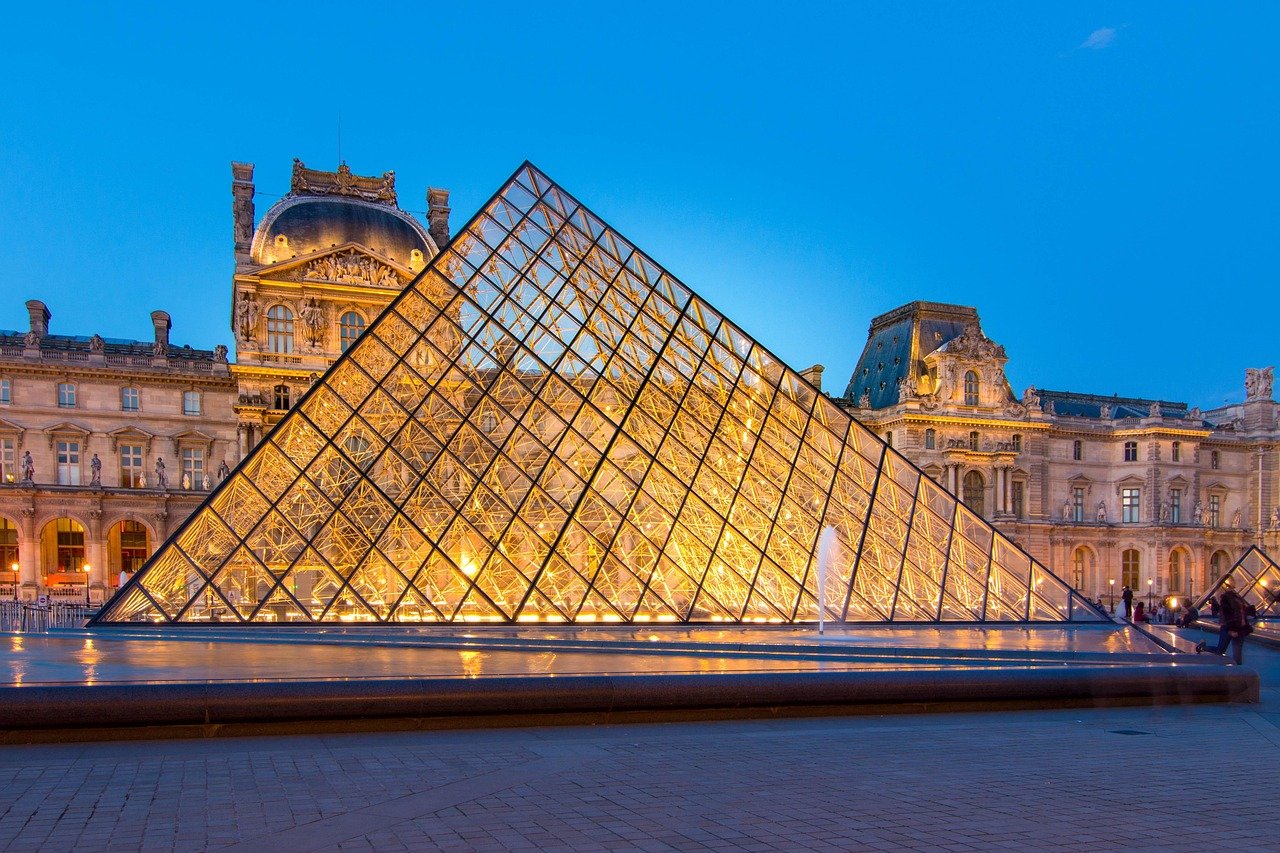
- Pyramid entrance (Pyramide): The iconic photo spot, and also the busiest queue by far. Ticket and pass holders use the green lane; anyone buying on the spot uses the orange lane (expect a real wait in peak season).
- Carrousel du Louvre shopping mall entrance: Navigate to "Carrousel du Louvre," walk through the underground mall, and you'll find the Louvre entrance next to the inverted pyramid — a relatively under-the-radar route.
- Porte des Lions: On the riverside, marked by bronze lion statues out front. Ticket holders only, closed on Tuesdays. Last entry is 5pm, and you can't exit through this door after 6pm — the coat check here also closes at 5pm, and there's no audio guide or printed map available at this entrance.
- Passage Richelieu: Group-tour entrance only; independent visitors won't need this one.
A 1.5-hour highlights route
If you're short on time, here's a condensed version of the museum's own "Masterpieces" route:
- Enter through the Sully wing and glance at the Louvre's medieval moat foundations (dating back to the fortress's original construction in 1190)
- Sully, ground floor: the Great Sphinx of Tanis (Room 338) → Venus de Milo (Room 345)
- Head up to Denon, first floor: the Winged Victory of Samothrace (Room 703 — it stands at the top of the grand staircase and it's genuinely striking)
- Denon, first floor, Room 7xx: the Mona Lisa (Room 711) and the French and Italian paintings around it
- Denon, ground floor: Michelangelo's sculpture The Dying Slave / The Rebellious Slave (Room 403)
This route skips the Richelieu wing entirely. If you have more time, add a stop at Richelieu's ground-floor Cour Marly (sculpture courtyard) and the Code of Hammurabi (Room 227). Note that Louvre floor numbering is one off from what you might expect: what the map calls "ground floor" (level 0) is what many visitors would call the first floor, and "level 1" is the second floor. Pick up a free paper map at the entrance to keep your bearings.
The "big three"
Mona Lisa — Denon, first floor, Room 711 Painted by Leonardo da Vinci starting in 1503, and carried with him when he moved to France late in life to work for the French king. After his death, the king bought it from his assistant. In 1911 the painting was stolen by a house painter who believed it belonged in Italy; he was caught two years later trying to sell it to the Uffizi in Florence, and the resulting press coverage is a big part of why the painting is so famous today. It's smaller than most people expect — just 77 x 53 cm — and the room in front of it is reliably the most crowded spot in the museum.
Venus de Milo — Sully, ground floor, Room 345 A Greek sculpture from around 130-100 BC, discovered on the island of Milos. Famous for its missing arms, and often cited as a study in idealized proportion — the ratio between head, torso, and legs is close to the golden ratio.
Winged Victory of Samothrace — Denon, first floor, Room 703 Dating to roughly the 2nd century BC, this is one of the few surviving Greek originals (not a Roman copy) from the period. It stands 2.44 meters tall on a marble base shaped like a ship's prow, was discovered on the island of Samothrace, and now presides over the top of Denon's grand staircase.
Other must-sees (non-painting)
| Work | Location | Why it matters |
|---|---|---|
| Code of Hammurabi | Richelieu, ground floor, Room 227 | Ancient Babylonian law code carved into a basalt stele — the origin of "an eye for an eye" |
| Lamassu (winged human-headed bulls) | Richelieu, ground floor, Room 229 | Assyrian guardian figures, typically found flanking palace gates |
| Seated Scribe | Sully, first floor, Room 635 | Old Kingdom Egyptian sculpture with inlaid rock-crystal eyes |
| Great Sphinx of Tanis | Sully, ground floor, Room 338 | Carved granite sphinx, roughly 26th century BC |
| Cour Marly sculptures | Richelieu, level -1, Room 102 | Originally from Louis XIV's Château de Marly gardens; look for the Marly Horses |
| The Dying Slave / The Rebellious Slave | Denon, ground floor, Room 403 | Michelangelo, 1513-1516, 2.15 meters tall |
Other must-sees (paintings)
Denon, first floor, Room 7xx (same floor as the Mona Lisa, mostly French and Italian painting): Liberty Leading the People (Delacroix, Room 700), The Coronation of Napoleon (David, 1807 — at 9.79 meters wide, the second-largest canvas in the Louvre, Room 702), The Wedding at Cana (Veronese — the largest canvas in the museum, hung in the same room as the Mona Lisa), The Virgin and Child with St. Anne and Virgin of the Rocks (both Leonardo, Room 710), The Raft of the Medusa (Géricault, Room 700), La Grande Odalisque (Ingres, Room 702).
Richelieu, second floor, Room 8xx (Northern European and French painting): The Lacemaker (Vermeer, Room 837 — tiny, just 24.5 x 21 cm), Gabrielle d'Estrées and One of Her Sisters (School of Fontainebleau, Room 824), Bathsheba at Her Bath (Rembrandt, Room 844), Ship of Fools (Bosch, Room 815).
Sully, second floor, Room 9xx (French painting): The Turkish Bath and La Grande Baigneuse (both Ingres, Room 940), The Cheat with the Ace of Diamonds (Georges de La Tour, Room 912).
A short history of the Louvre
The Louvre started life in 1190 as a fortress and prison. In the 14th century, Charles V moved his residence there, becoming the first king to actually live at the Louvre. François I rebuilt it as a palace starting in 1546, and subsequent kings kept expanding it. During the French Revolution, in 1793, it opened to the public as a museum. In 1989, marking the Revolution's bicentennial, I.M. Pei's glass pyramid was unveiled and became the museum's iconic main entrance. The collection is spread across three wings: Denon, Sully, and Richelieu.
Getting there and where to stay nearby
Metro: Palais-Royal – Musée du Louvre (lines 1, 7), Pyramides (line 14)
Nearby: Tuileries Garden, Musée de l'Orangerie, Place de la Concorde — and it's a walkable distance across the Seine to the Musée d'Orsay
Where to stay: The Louvre sits in Paris's 1st arrondissement, which is generally safe. Châtelet-Les Halles, a major transit hub with a direct RER B line to Charles de Gaulle Airport, is a short walk east. The area near the Opéra to the north has CDG airport shuttle buses, which is handy if you're planning a late Friday-night visit and heading straight back to your hotel.
Hotels near the Louvre (1st arrondissement)
Booking · from €140
3-15 minutes on foot from the Louvre, close to the Châtelet or Opéra transit hubs
This is an affiliate link — we may earn a commission at no extra cost to you.
FAQ
Is there an audio guide? Yes, about €6 to rent, available at both the Pyramid entrance and the Carrousel mall entrance. Not available at Porte des Lions.
Is there free luggage storage? Yes, under the pyramid (accessible from the Pyramid and Carrousel entrances) and at Porte des Lions. Size limit is 55 x 35 x 20 cm, and the Porte des Lions storage closes at 5pm.
Can I bring a stroller? Yes. Larger strollers are best checked at the coat room, with free baby carriers available to borrow inside (front-carry only). Free wheelchairs and folding stools are also available under the pyramid, and visitors with mobility needs can use priority access at the Pyramid entrance.
When's the least crowded time to visit? The first 30 minutes after opening, and the extended Friday evening hours — both reliably dodge the big tour-group crush.
What exactly are the "big three" at the Louvre? The Mona Lisa, the Venus de Milo, and the Winged Victory of Samothrace.
If you're also planning to visit Versailles or the Musée d'Orsay, it's worth checking whether the Paris Museum Pass actually saves you money on your specific itinerary.